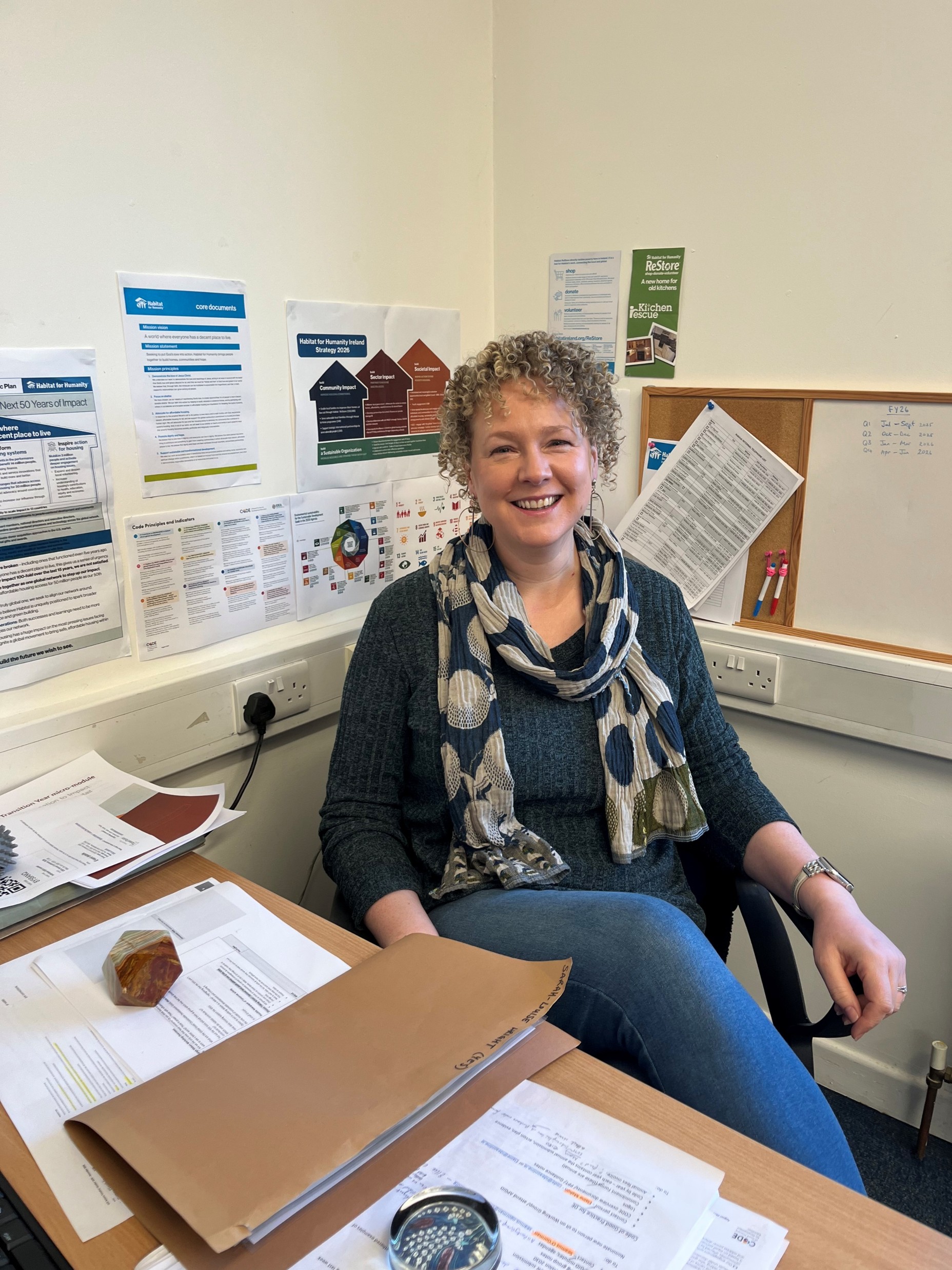
The next in our series of Lent Devotions comes from Emma Lutton, Habitat's Global Education Programme Manager.
We often live with a quiet assumption that there is not enough. Not enough space. Not enough resources. Not enough to go around. And so, without even realising it, we begin to live defensively. We hold tightly to what we have, measuring what is ours and drawing our circle of concern that little bit smaller.
Perhaps you’ve been asked before if you are a glass half empty or a glass half full kind of person. An optimist or a pessimist, someone who sees scarcity or plenty?
It’s a neat question. But it’s also a limited one.
I saw a sketch recently that turned the whole idea on its head. In the final frame of a series of ‘perspectives’, the glass wasn’t about optimism or pessimism at all—it was simply a jar for washing out paintbrushes. In one small scribble, a completely different way of seeing emerged.
And it got me thinking.
What if the Christian life is less about choosing between “not enough” and “just enough,” and more about learning to see differently altogether?
In the gospel narrative, when a crowd gathers and hunger sets in, the disciples see only scarcity—five loaves, two fish, and far too many people. But Jesus sees something else. He takes what is offered, gives thanks, and begins to share. And somehow, in that moment, there is enough. More than enough.
This is not simply a miracle of multiplication. It is a reordering of imagination.
Because when it comes to something as basic as home, the issue is not only how much there is, but how we see it—and how we share it. In a world where some have more than they need and others have virtually nothing at all, scarcity is not just about supply, but about vision.
Christ helps us to see differently: to recognise abundance where we assumed scarcity, to see neighbours where we once saw strangers, and to discover that, in God’s household, there is enough—for all to find a place to call home.
In our interconnected world, our lives are already bound together—across streets and across continents. The question is whether we will live as if that is true. Our hope at Habitat is that, by providing practical tools and opportunities to lean into this reimagining of resources and relationships, each of us will be able to see and live differently, together.